


- This event has passed.
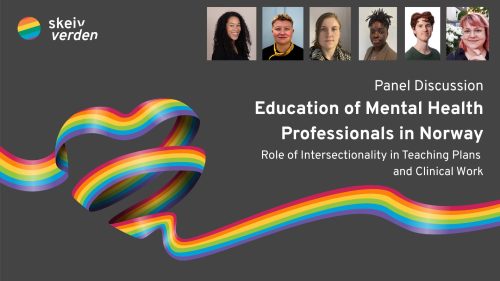
In this panel, we'll address the role and importance of intersectionality in the education of mental health professionals in Norway.
Minority groups, such as sexual, ethnic and other minorities, experience more often mental health challenges due to minority stress, in combination with discriminatory experiences and microaggressions. These challenges often become more complex for those with multiple minority identities. Understanding these challenges and how to address them when working with clients with minority identities is crucial for mental health professionals, including psychologists and counsellors.
Join us for a discussion on whether and how the current curricula approach intersectionality and minority stress and what is needed in clinical work to provide better mental health support for individuals with minority identities and to avoid the replication of discriminatory experiences inside the therapy rooms.
Our panellists are:
- Winnie Nyheim-Jomisko (she/her): Psychologist and speaker at the Centre for Intersectionality
- Sam Fluit (he/him): Political psychologist & lecturer at the University of Oslo
- Mar Dokken (they/them): Psychologist at the Regional Centre for Gender Incongruence in Vestfold
- Dr Ziada Ayorech (she/her): Course coordinator and lecturer at the University of Oslo & Postdoctoral Research Fellow in Psychiatric Genetics at the PROMENTA Research Centre
- Jacob Evje (he/him): Doctoral Research Fellow at PROMENTA, the Department of Psychology at University of Oslo
Chair of the panel:
- Anastasia Izotova (she/they): Doctoral Research Fellow at the PsychGen Centre for Genetic Epidemiology and Mental Health, NIPH & LDS
In this panel, we address the role and importance of intersectionality in the education of mental health professionals in Norway.
Minority groups, such as sexual, ethnic and other minorities, are more likely to experience mental health challenges as a result of minority stress, combined with discriminatory experiences and microaggressions. These challenges are often more complex for people with multiple minority identities. Understanding these challenges - and how to address them when working with minority clients - is crucial for mental health professionals, including psychologists and counsellors.
Join us for a conversation about whether and how current educational programmes address intersectionality and minority stress, and what is needed in clinical work to provide better mental health care to people with minority identities - and to avoid discriminatory experiences being repeated in therapy.
Our panellists are:
- Winnie Nyheim-Jomisko (she/her): Psychologist and lecturer at the Centre for Intersectionality
- Sam Fluit (he/him): Political psychologist and senior lecturer at the University of Oslo
- Mar Dokken (they/them): Psychologist at the Regional Centre for Gender Incongruence in Vestfold
- Dr Ziada Ayorech (she/her): Course coordinator and senior lecturer at the University of Oslo & postdoctoral researcher in psychiatric genetics at the PROMENTA centre
- Jacob Evje (he/him): Research fellow at PROMENTA, Department of Psychology, University of Oslo
Panel leader:
- Anastasia Izotova (she/they): Research fellow at PsychGen - Centre for Genetic Epidemiology and Mental Health, NIPH & LDS

