
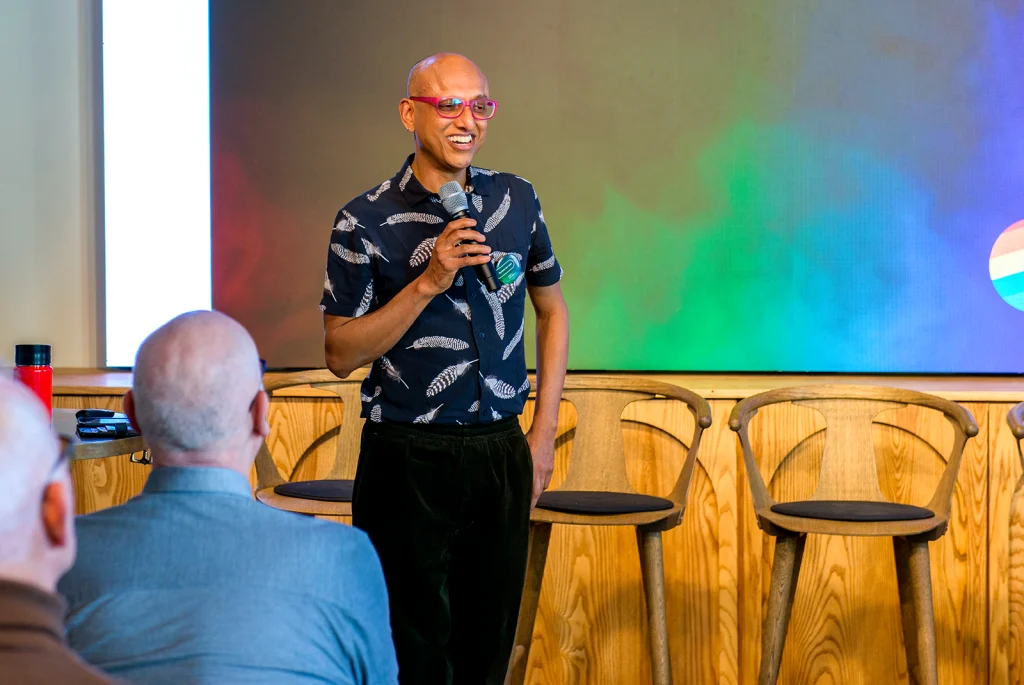
At Skeiv Verden's international conference on intersectionality Dr Roshan das Nair shared compelling findings from a groundbreaking study on minority stress in Norway, which he co-led with Dr Kari Sand.
The project was funded by Bufdir. As both a senior researcher at SINTEF's health department and someone who recently migrated to Norway himself, das Nair brought unique insights into how minority stress affects various communities.
Through an innovative photovoice-study, das Nair and his team collected not only photographs, but also drawings, videos and various other "artefacts" that represented participants' experiences of minority stress. These, along with personal narratives, revealed several key themes:
Participants shared how their physical appearance often made them targets of discrimination - from clothing choices to visible disabilities. One participant described having to consciously wear muted colors to "assimilate", while another spoke about the challenges of navigating public spaces in a wheelchair.
For immigrants, language emerged as a significant source of stress. das Nair highlighted how even fluent Norwegian speakers struggle with the dilemma of which language to use in professional settings - speaking imperfect Norwegian might lead to judgment, while using English could be seen as a failure to integrate.
The research revealed a complex dynamic where individuals either felt hypervisible (constantly scrutinized) or invisible (ignored or overlooked). Some participants described being asked invasive personal questions, while others spoke about being or feeling completely erased from official communications.
das Nair emphasised that minority stress manifests itself across various settings:
The study found that individuals employ various coping mechanisms, ranging from:
das Nair's research underscores the need for:
The study serves as a crucial reminder that while Norway is often seen as a progressive society, many minorities still face significant challenges in their daily lives. As das Nair pointed out, understanding these experiences is the first step toward creating more inclusive institutions and support systems.