
Islam is the second largest religion in the world, with approximately two billion followers. It is practised in different ways in different parts of the world, such as Southeast Asia, the Middle East and Europe, and interpretations of Islam vary according to local traditions and history.
When Abid Raja tries to warn against conservative aspects of Islam and draws a sharp distinction between "Norwegianness" and "the other", we feel that he creates more distance and division than understanding and dialogue.
Raja's rhetoric is part of a larger trend in which fear of Muslims and Islam is used politically. This can reinforce prejudices and overlook the many different perspectives that exist in the religion. His interpretation of Islam is reminiscent of both conservative Muslims and right-wing extremists, which ignores more liberal and inclusive views.
There are many challenges for queer Muslims in Norway, but we feel that Abid Raja creates more distance and division than understanding and dialogue.
Raja claims that Islam does not accept homosexuality, but we find it problematic that he uses such a strict interpretation when he also wants to promote a more open and inclusive form of Islam. This helps to perpetuate prejudices that Islam is an intolerant religion, while the many inclusive interpretations are overlooked.
For queer Muslims in Norway, the challenges are many. They often face discrimination from two sides - both queerphobia from their own religious or cultural circles, and racism and Islamophobia from society at large. While we agree with Raja that there are challenges around homosexuality in some Muslim communities, we believe he overlooks the larger issues of racism and Islamophobia that queer Muslims face in Norwegian society.
We would like to challenge Raja's use of school pupils' opinions as a basis for drawing conclusions about how Islam and Muslims relate to homosexuality. Through many years of dialogue work, we have seen that there is room for discussion and the development of more open interpretations of Islam, also in meetings with mosques. For example, the dialogue work under the auspices of STL in recent years has shown that progressive Islam can be part of the conversation.
We've also worked closely with children and young people, and we see that many of them ask us questions about queerness with openness and curiosity. Intolerance towards queer people often stems from a lack of knowledge and understanding, and this applies not only to Muslims, but also to pupils with a majority Norwegian background.
For several years, we have worked with dialogue between Muslim communities and other groups, and we see that it is possible to create understanding and discuss more liberal interpretations of Islam. Intolerance is often the result of a lack of knowledge, not only in Muslim communities, but also among the majority in Norway.
It is important for us to point out that it is problematic when politicians use Muslims and queer people as pawns in a political game about who should be protected, and from what. Such rhetoric reduces people to political tools and overlooks the actual challenges we all face.
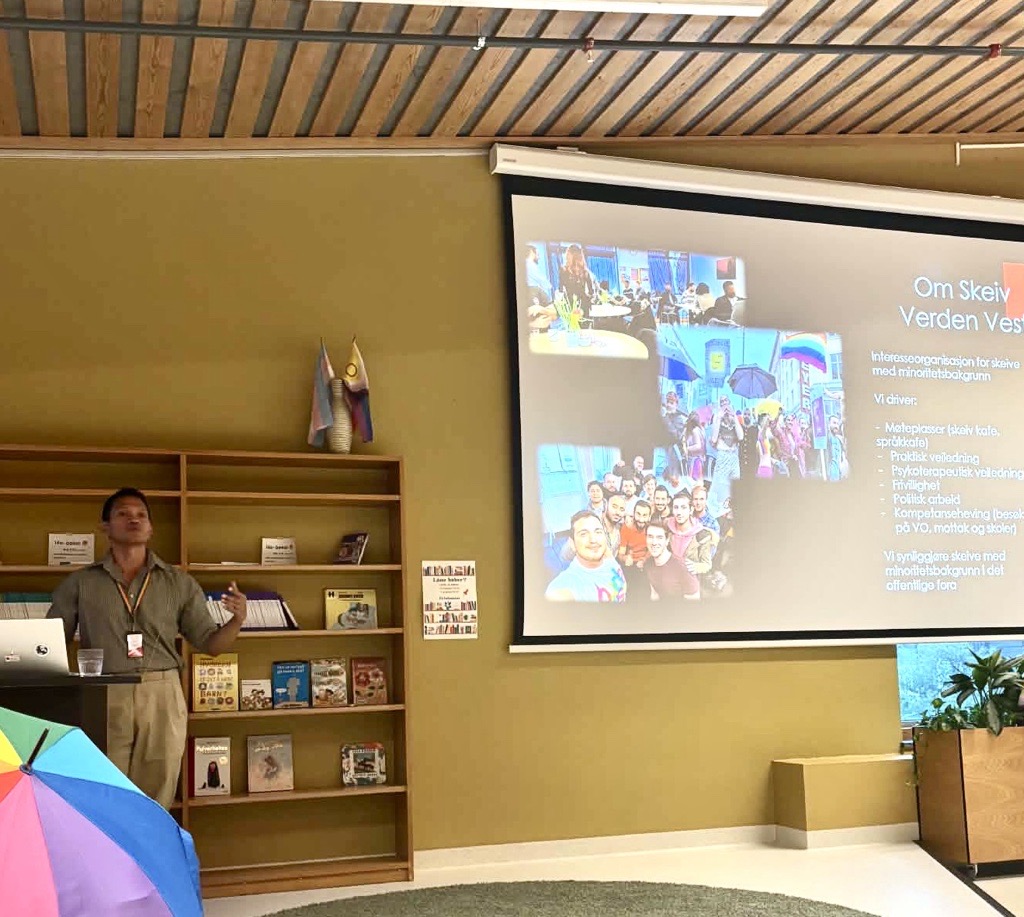
We invite Abid Raja to explore how we at Hikmah House and Queer World work to prevent negative social control and honour-based violence, and to collaborate with us in this important work.
- Here is the survey of living conditions among queer people with an immigrant background
- The dialogue between religious leaders and queer people
- Here is the study on restraints and negative social control on young, minority Norwegian men
- Experiences of discrimination among Muslims in Norway 2022
- International Day for Combating Islamophobia, 2023, United Nations
- Why did Muslims become the new enemy in Norway and Europe?
- A Growing Consensus? A History of Public Debates on Islamophobia in Norway (2020)